
Views: 108 Author: Site Editor Publish Time: 2026-01-12 Origin: Site


In modern panel processing and furniture manufacturing, especially in whole-house customization factories, sanding lines increasingly face mixed-batch production: panels with different thicknesses, materials, and surface conditions running continuously on the same line.
To achieve stable surface quality under these conditions, sanding systems must adapt dynamically rather than rely on fixed pressure settings. One proven and industrially mature solution is the cylinder-controlled segmented pad (CSP) combined with laser thickness detection.This article explains the engineering principles behind CSP systems, how laser thickness detection enhances pressure compensation, and why this technology is particularly effective for mixed-batch production environments.
A cylinder-controlled segmented pad system consists of multiple narrow pressure segments arranged across the sanding width. Each segment is actuated by a pneumatic cylinder, allowing localized pressure adjustment instead of uniform pressure across the entire sanding belt.
Key characteristics:
Segmented pressure distribution across the sanding width
Pneumatic cylinder actuation
Mature and reliable mechanical structure
Well suited for continuous industrial operation
CSP systems are widely used in high-quality wide belt sanders where adaptability and robustness are required.
Laser thickness detectors measure the actual thickness of incoming panels before sanding contact. This data provides a real-time reference for surface variation and material inconsistency.
When integrated with a CSP system, laser thickness detection enables:
Pre-compensation for panel thickness variation
Adaptive pressure adjustment per segment
Reduced reliance on mechanical presetting
Instead of reacting after sanding defects occur, the system anticipates variation and adjusts proactively.
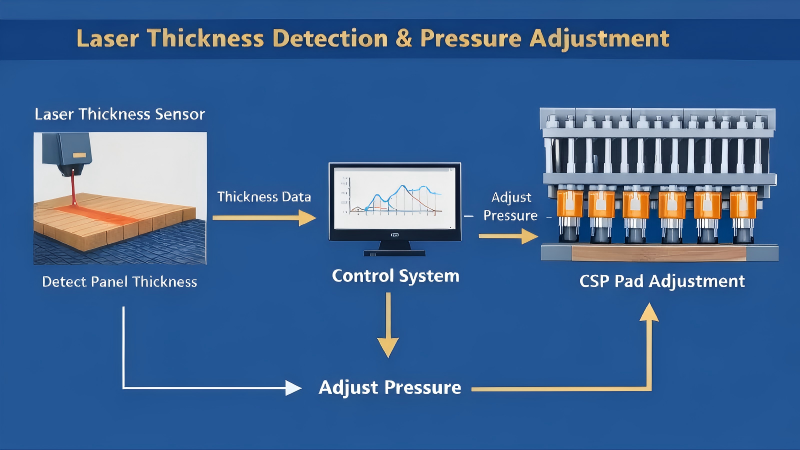
The typical control logic follows this sequence:
Panel enters the sanding line
Laser thickness detector scans the panel surface
Thickness data is transmitted to the control system
Rollers do self-adjustment for height changing
Pneumatic cylinders adjust accordingly
Sanding is performed with compensated pressure distribution
This approach significantly improves consistency when processing panels with non-uniform thickness.
Mixed-batch production is common in whole-house customization factories, where different panel sizes, substrates, and surface treatments are processed continuously.
CSP systems offer several advantages in this scenario:
High tolerance to thickness variation
Stable pressure output under long production cycles
Fast adaptation when combined with laser detection
Reduced manual intervention and setup time
These characteristics make CSP particularly suitable for flexible manufacturing environments.
Although pneumatic systems are sometimes perceived as “traditional,” they offer important engineering benefits:
Proven reliability in industrial environments
Simple maintenance and serviceability
Strong resistance to dust, vibration, and temperature variation
Predictable behavior over long production shifts
When paired with intelligent sensing and control logic, pneumatic systems remain highly competitive for many high-end applications.
SMOOTH has accumulated extensive experience with cylinder-controlled segmented pad systems integrated with laser thickness detection. These systems are currently deployed in customer factories and have received positive feedback, particularly for:
Mixed-batch sanding operations
Whole-house customization production lines
Veneer and substrate sanding requiring consistency
This practical field experience forms the technical foundation of SMOOTH’s segmented pad expertise.
Cylinder-controlled segmented pads represent a stable and reliable platform upon which more advanced control technologies—such as force closed-loop or electromagnetic actuation—can be explored.
By mastering segmented pressure distribution, sensing integration, and control logic at the CSP level, manufacturers establish a solid engineering base for future system evolution.
The combination of cylinder-controlled segmented pads and laser thickness detection offers a proven and effective solution for high-quality sanding in mixed-batch production environments. Its balance of adaptability, robustness, and industrial maturity makes it especially suitable for whole-house customization factories.
This technology continues to play an important role in modern wide belt sanding systems and provides a strong foundation for further advancements in pressure control and surface finishing.
This article is intended for technical reference and engineering discussion. System configurations and control strategies may vary depending on application requirements.


